参考资料
- https://langfuse.com/self-hosting/deployment/kubernetes-helm
- https://langfuse.com/handbook/product-engineering/architecture
- https://langfuse.com/self-hosting/configuration
- https://blog.bitipcman.com/post/strands-agents-part-2
部署自托管langfuse配置
在EKS集群部署场景下除了修改镜像使其可获取外,还需要修改如下配置values配置
# https://artifacthub.io/packages/search?repo=langfuse-k8s
helm show values langfuse/langfuse > values.yaml
langfuse涉及到的大量组件都需要额外的存储卷支持,可以通过在全局存储类中指定
global:defaultStorageClass: "ebs-sc"
为了避免用户名密码登录可以集成GitHub OAuth
langfuse:auth:disableUsernamePassword: trueproviders:github:clientId: "Ov23lifclq3GFzMZc3OD"clientSecret: "9b489df5ab7fc81a05aacc6c3d5d3c44643d10a5"
此外,开启oauth之后还需要设置NextAuth URL 配置,主要用于SSO登录后重定向。否则在登录后被重定向到 localhost:3000 ,例如我挂载在ALB上使用ALB的域名跳转
nextauth:url: http://xxxx-18b493b28db5ed26.elb.cn-northwest-1.amazonaws.com.cn:3000
加密配置如下,可以用openssl生成随机字符
- langfuse.salt.value:API 密钥哈希盐值
- langfuse.encryptionKey.value:敏感数据加密密钥 (256 bits)
- langfuse.nextauth.secret.value:NextAuth JWT 加密密钥
数据库配置,需要指定username和password,也可以用openssl生成随机字符。这些组件的作用为
- PostgreSQL:存储事务性数据(用户、组织、项目、API 密钥、提示、数据集、作为裁判的 LLM 设置)
- Redis:存储高频访问的数据,减轻 PostgreSQL 的压力,以及作为事件队列
- ClickHouse:存储跟踪数据(跟踪记录、观察结果、评分)。负责大规模日志和指标分析。需要查询过去一个月的 token 消耗趋势、响应时间分布图、或者进行复杂的聚合查询时
- MinIO:存储大型的非结构化数据,通常是 Prompt 或 LLM 的完整响应内容,以及多模态附件(图像、音频)
postgresql:deploy: trueauth:username: postgrespassword: "6de00804e0671f56b76b5da6fc50d7b5"database: postgres_langfusemigration:autoMigrate: true
redis:deploy: trueauth:username: "default"password: "97556be00e7c93918c791420e2e28de6"database: 0
clickhouse:deploy: trueshards: 1replicaCount: 3resourcesPreset: 2xlargeclusterEnabled: trueauth:username: defaultpassword: "31yx5qnjfjofRBjFxteGJju5x9nhZRbo"
s3:deploy: truestorageProvider: "s3"forcePathStyle: trueauth:accessKeyId:value: "minio"secretAccessKey:value: "minio123"
部署命令
# 添加 Helm 仓库
helm repo add langfuse https://langfuse.github.io/langfuse-k8s
helm repo update# 部署应用
helm upgrade -i langfuse langfuse/langfuse -f values.yaml
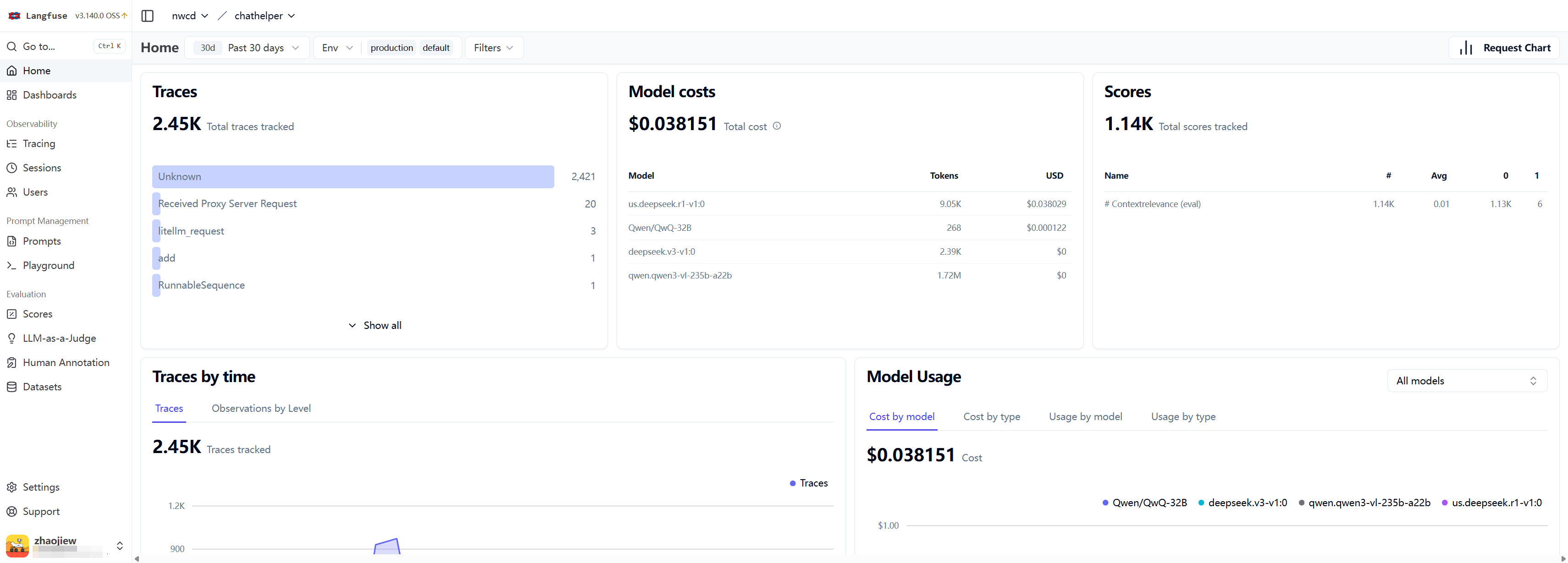
访问控制台结果如下
通过@observe注入函数调用
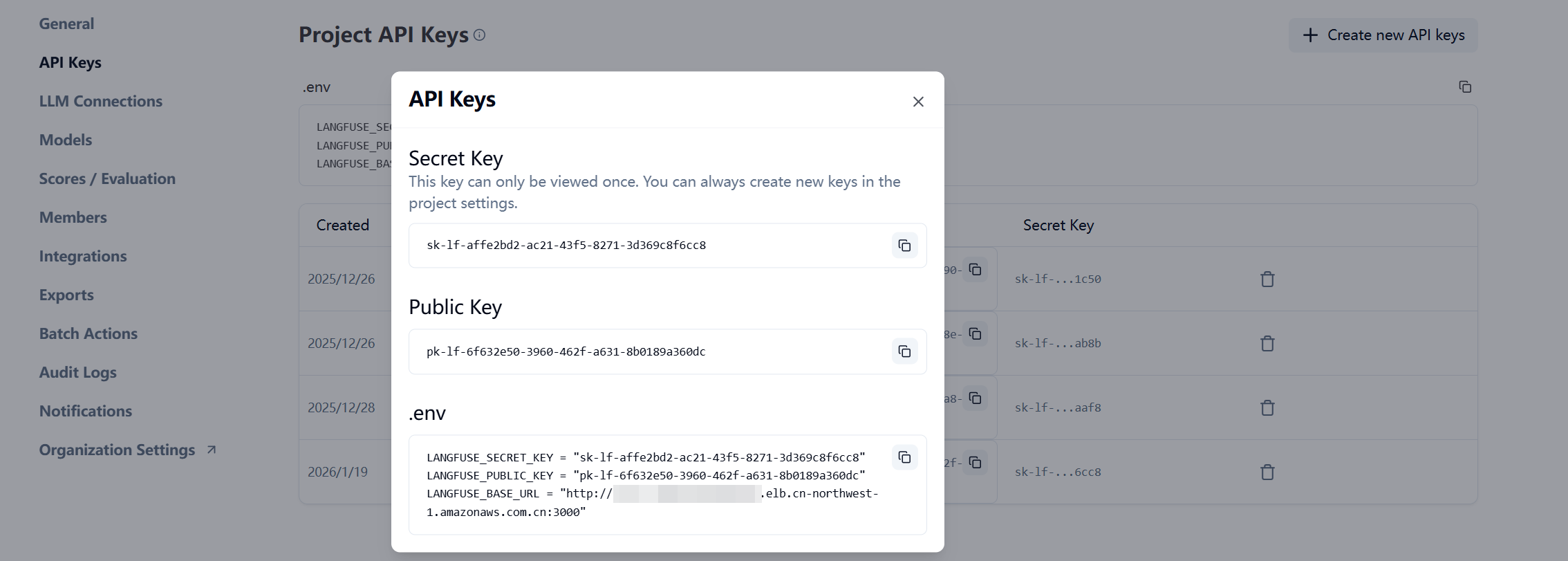
在langfuse申请apikey
LANGFUSE_SECRET_KEY = "sk-lf-862d03b4-17cd-4ac7-a5d6-b66acdf50340"
LANGFUSE_PUBLIC_KEY = "pk-lf-0ea7a9b4-7ed6-4b34-8364-e3a0b3576e37"
LANGFUSE_BASE_URL = "http://langfuse-web.aitao.group:3000"
使用如下测试代码了解trace的逻辑
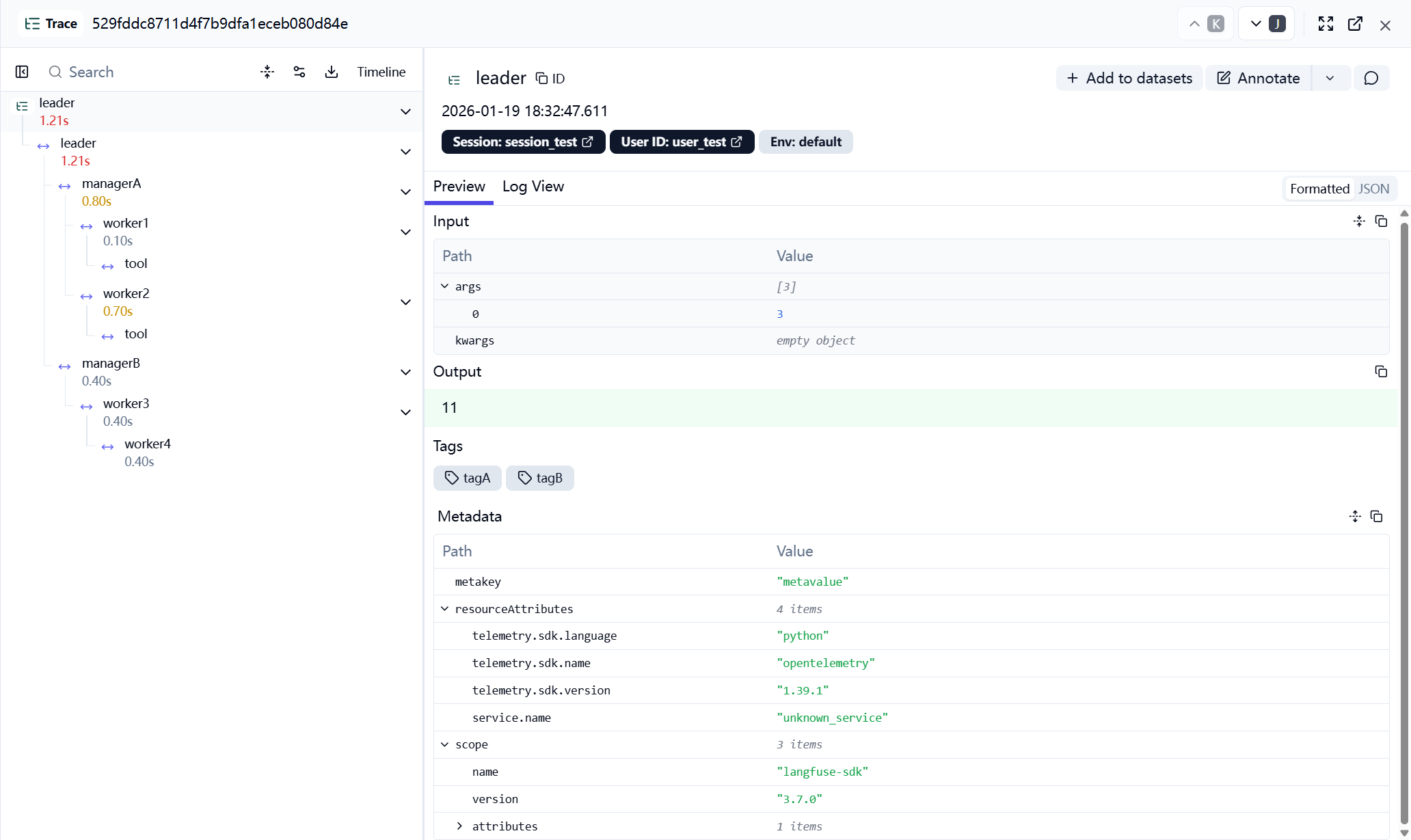
- 在代码中使用@observe自动注入,Langfuse 会在后台维护一个 调用栈上下文。
- 用户信息 (
user_id)、会话信息(session_id) 和 标签 (tags) 会被上传到 Langfuse 服务器,方便你后续根据用户或特定标签进行搜索和分析成本。 @observe装饰器会在函数进入时记录时间戳,并在函数返回时再次记录。两者相减就得到了每个环节的耗时(Latency)
import uuid
import time
from langfuse import Langfuse, observetrace_id = uuid.uuid4().hexlf = Langfuse(secret_key="sk-lf-862d03b4-17cd-4ac7-a5d6-b66acdf50340",public_key="pk-lf-0ea7a9b4-7ed6-4b34-8364-e3a0b3576e37",host="http://langfuse-web.aitao.group:3000",
)@observe
def tool(name: str) -> str:return f"{name} says hi!"@observe
def worker1(x: int) -> int:time.sleep(0.1)tool("work1tool")return x + 1@observe
def worker2(x: int) -> int:time.sleep(0.7)tool("work2tool")return x + 2@observe
def worker3(x: int) -> int:worker4(x)return x + 2@observe
def worker4(x: int) -> int:time.sleep(0.4)return x + 2@observe
def managerA(x: int) -> int:y = worker1(x)z = worker2(y)return z@observe
def managerB(x: int) -> int:y = worker3(x)return y@observe
def leader(x: int) -> int:lf.update_current_trace(user_id="user_test",session_id="session_test",metadata={"metakey": "metavalue"},tags=["tagA", "tagB"])y = managerA(x)z = managerB(x)return y + zif __name__ == "__main__":leader(3, langfuse_trace_id=trace_id)
trace的具体内容如下
strands agent集成langfuse
来源参考https://blog.bitipcman.com/post/strands-agents-part-2,应用的架构说明如下
┌─────────────┐   ┌─────────────┐   ┌─────────────┐
│  HR Agent  │────▶│Employee Agent│────▶│ MCP Server  │
│ (Client)   │ A2A  │ (Remote)   │ MCP  │ (Data)    │
│ Port: 8000  │    │ Port: 8001   │    │ Port: 8002  │
└─────────────┘   └─────────────┘   └─────────────┘
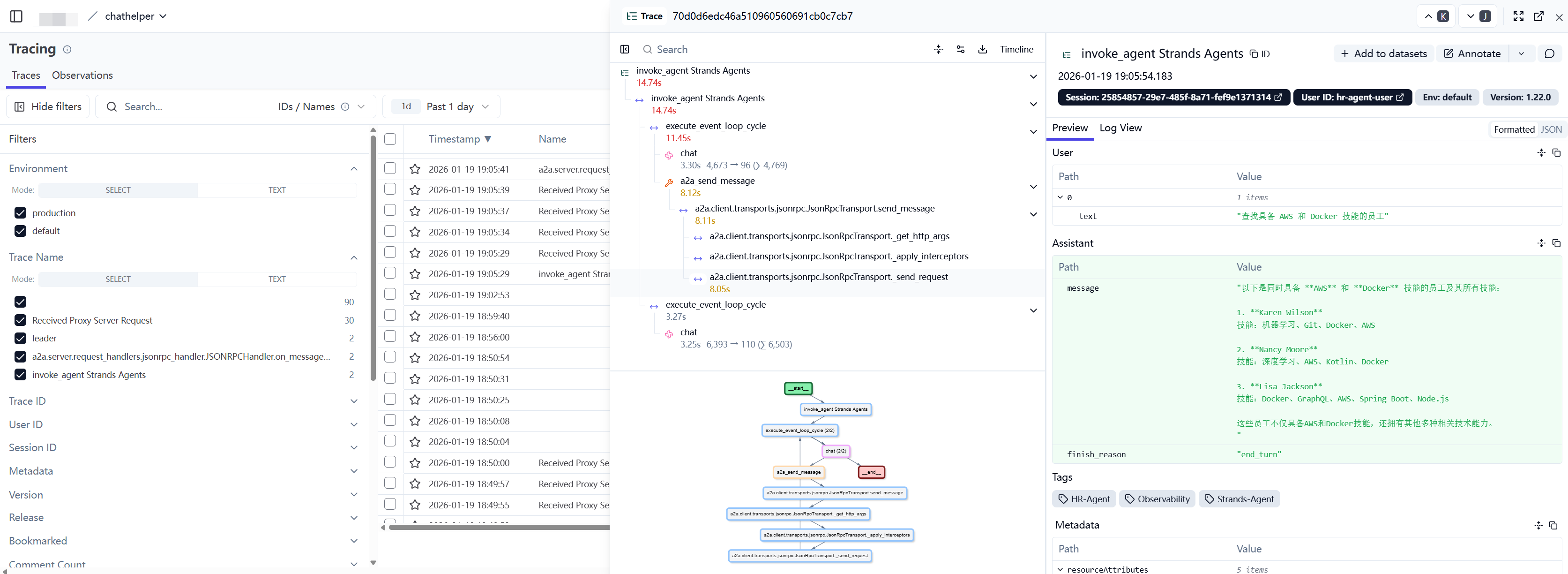
观测效果如下
实现hr_agent
# /home/ec2-user/strandsagent/hr-agent/hr_agent.py
"""HR Agent - Client Agent,通过 A2A 协议访问 Employee Agent"""
import os
import uuid
import base64
import uvicorn
from strands import Agent
from strands.models.openai import OpenAIModel
from strands_tools.a2a_client import A2AClientToolProvider
from strands.telemetry import StrandsTelemetry
from fastapi import FastAPI
from fastapi.responses import StreamingResponse
from pydantic import BaseModel# 配置环境变量
APIKEY = "sk-uzpq0u0n5FN14HorW45hUw"
EMPLOYEE_AGENT_URL = os.environ.get("EMPLOYEE_AGENT_URL", "http://localhost:8001/")# 配置 Langfuse
os.environ["LANGFUSE_PUBLIC_KEY"] = "pk-lf-0ea7a9b4-7ed6-4b34-8364-e3a0b3576e37"
os.environ["LANGFUSE_SECRET_KEY"] = "sk-lf-862d03b4-17cd-4ac7-a5d6-b66acdf50340"
os.environ["LANGFUSE_BASE_URL"] = "http://langfuse-web.aitao.group:3000"# 构建 Basic Auth 头
LANGFUSE_AUTH = base64.b64encode(f"{os.environ.get('LANGFUSE_PUBLIC_KEY')}:{os.environ.get('LANGFUSE_SECRET_KEY')}".encode()
).decode()# 配置 OpenTelemetry 端点和头部
os.environ["OTEL_EXPORTER_OTLP_ENDPOINT"] = os.environ.get("LANGFUSE_BASE_URL") + "/api/public/otel"
os.environ["OTEL_EXPORTER_OTLP_HEADERS"] = f"Authorization=Basic {LANGFUSE_AUTH}"# 配置遥测
strands_telemetry = StrandsTelemetry().setup_otlp_exporter()app = FastAPI(title="HR Agent API")class QuestionRequest(BaseModel):question: str@app.get("/health")
def health_check():return {"status": "healthy"}# 配置 DeepSeek 模型
deepseek_model = OpenAIModel(model_id="qwen.qwen3-vl-235b-a22b",client_args={"api_key": 'sk-MSX0wjXwPSOL5dA3VZPKFg',"base_url": "http://litellm.aitao.group:4000",},
)# 创建 A2A 工具提供者
provider = A2AClientToolProvider(known_agent_urls=[EMPLOYEE_AGENT_URL])# 创建 HR Agent
agent = Agent(model=deepseek_model,tools=provider.tools,system_prompt="Use a2a agents to access employee information you don't otherwise have access to. 请用中文回答用户的问题。",trace_attributes={"session.id": str(uuid.uuid4()),"user.id": "hr-agent-user","langfuse.tags": ["HR-Agent", "Strands-Agent", "Observability"],"agent.name": "HR-Agent"}
)@app.post("/inquire")
async def ask_agent(request: QuestionRequest):"""处理用户咨询请求"""async def generate():stream_response = agent.stream_async(request.question)async for event in stream_response:if "data" in event:yield event["data"]return StreamingResponse(generate(), media_type="text/plain")@app.get("/")
async def root():"""API 根路径"""return {"message": "HR Agent API","endpoints": {"health": "/health","inquire": "/inquire (POST)",}}if __name__ == "__main__":uvicorn.run(app, host="0.0.0.0", port=8000)
实现employee_agent
# /home/ec2-user/strandsagent/hr-agent/employee_agent.py
import os
import base64
import uuid
from mcp.client.streamable_http import streamablehttp_client
from strands import Agent
from strands.models.openai import OpenAIModel
from strands.tools.mcp.mcp_client import MCPClient
from strands.multiagent.a2a import A2AServer
from strands.telemetry import StrandsTelemetry
from urllib.parse import urlparse# 配置环境变量
APIKEY = "sk-uzpq0u0n5FN14HorW45hUw"
EMPLOYEE_INFO_URL = os.environ.get("EMPLOYEE_INFO_URL", "http://localhost:8002/mcp/")
EMPLOYEE_AGENT_URL = os.environ.get("EMPLOYEE_AGENT_URL", "http://localhost:8001/")# 配置 Langfuse
os.environ["LANGFUSE_PUBLIC_KEY"] = "pk-lf-0ea7a9b4-7ed6-4b34-8364-e3a0b3576e37"
os.environ["LANGFUSE_SECRET_KEY"] = "sk-lf-862d03b4-17cd-4ac7-a5d6-b66acdf50340"
os.environ["LANGFUSE_BASE_URL"] = "http://langfuse-web.aitao.group:3000"# 构建 Basic Auth 头
LANGFUSE_AUTH = base64.b64encode(f"{os.environ.get('LANGFUSE_PUBLIC_KEY')}:{os.environ.get('LANGFUSE_SECRET_KEY')}".encode()
).decode()# 配置 OpenTelemetry 端点和头部
os.environ["OTEL_EXPORTER_OTLP_ENDPOINT"] = os.environ.get("LANGFUSE_BASE_URL") + "/api/public/otel"
os.environ["OTEL_EXPORTER_OTLP_HEADERS"] = f"Authorization=Basic {LANGFUSE_AUTH}"# 配置遥测
strands_telemetry = StrandsTelemetry().setup_otlp_exporter()# 配置 DeepSeek 模型
deepseek_model = OpenAIModel(model_id="qwen.qwen3-vl-235b-a22b",client_args={"api_key": 'sk-MSX0wjXwPSOL5dA3VZPKFg',"base_url": "http://litellm.aitao.group:4000",},
)
# 创建 MCP 客户端
employee_mcp_client = MCPClient(lambda: streamablehttp_client(EMPLOYEE_INFO_URL)
)with employee_mcp_client:# 获取 MCP 工具tools = employee_mcp_client.list_tools_sync()# 创建 Employee Agentemployee_agent = Agent(model=deepseek_model,name="Employee Agent",description="Answers questions about employees and their skills",tools=tools,system_prompt="When listing employees, show their full names and list all their skills. 请用中文回答问题。",trace_attributes={"session.id": str(uuid.uuid4()),"user.id": "employee-agent-user","langfuse.tags": ["Employee-Agent", "Strands-Agent", "Observability"],"agent.name": "Employee-Agent"})# 创建 A2A 服务器a2a_server = A2AServer(agent=employee_agent,host=urlparse(EMPLOYEE_AGENT_URL).hostname,port=urlparse(EMPLOYEE_AGENT_URL).port,http_url=EMPLOYEE_AGENT_URL)if __name__ == "__main__":a2a_server.serve(host="0.0.0.0", port=8001)
实现mcp server如下
# /home/ec2-user/strandsagent/hr-agent/mcp_server.py
from mcp.server.fastmcp import FastMCP
from employee_data import SKILLS, EMPLOYEESmcp = FastMCP("employee-server", stateless_http=True, host="0.0.0.0", port=8002)@mcp.tool()
def get_skills() -> set[str]:"""获取员工可能拥有的所有技能 - 使用此列表找出相关技能"""print("get_skills")return SKILLS@mcp.tool()
def get_employees_with_skill(skill: str) -> list[dict]:"""获取具有指定技能的员工 - 输出包括全名(名姓)和他们的技能"""print(f"get_employees_with_skill({skill})")skill_lower = skill.lower()employees_with_skill = [employee for employee in EMPLOYEESif any(s.lower() == skill_lower for s in employee["skills"])]if not employees_with_skill:raise ValueError(f"No employees have {skill} skill")return employees_with_skillif __name__ == "__main__":mcp.run(transport="streamable-http")
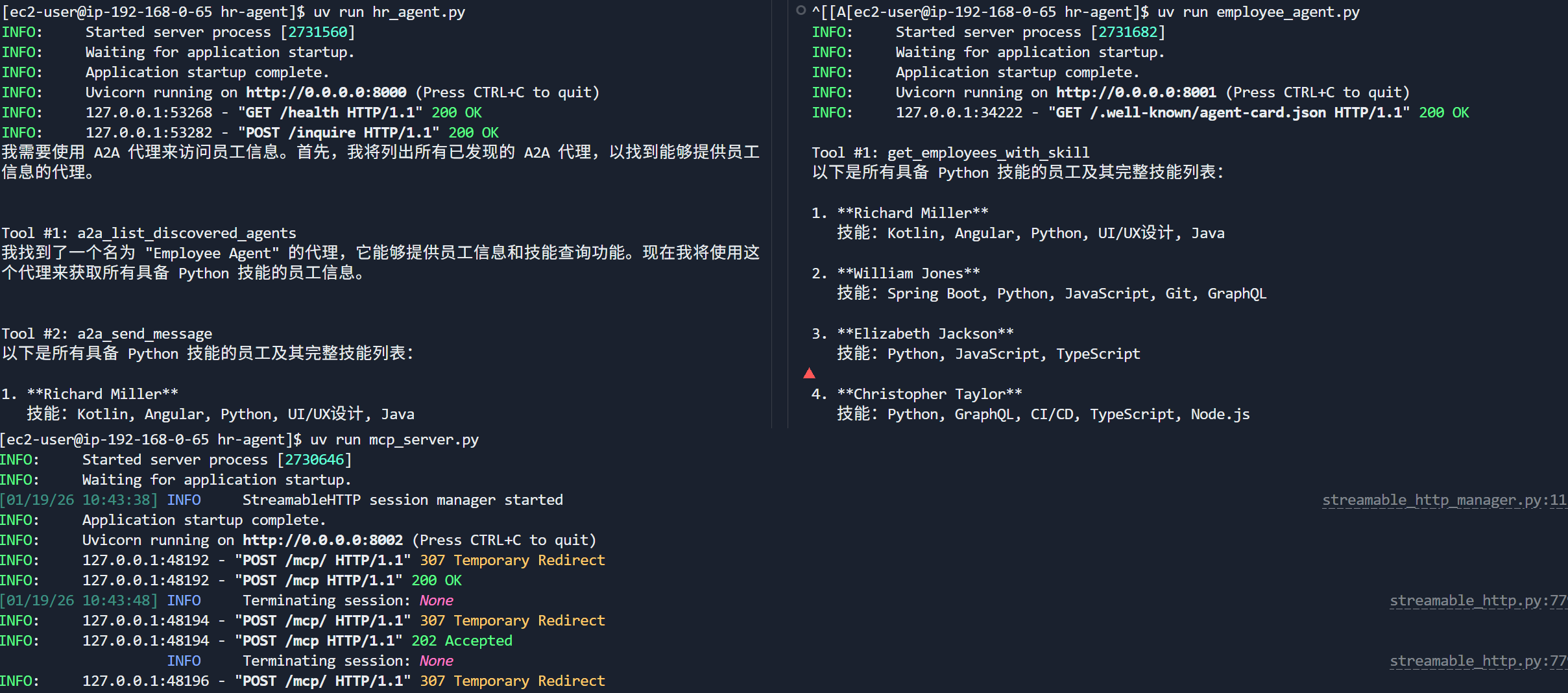
调用日志如下,可见
- hr_agent通过a2a card了解到可以通过employee_agent获取员工信息
- employee_agent了解到可以使用employee_mcp_client访问mcp服务器
- mcp则暴露了get_employees_with_skill供外部访问
当然以上的agent和mcp服务都可以通过通过网关(例如litellm)暴露出来,或者注册在nacos供外部使用